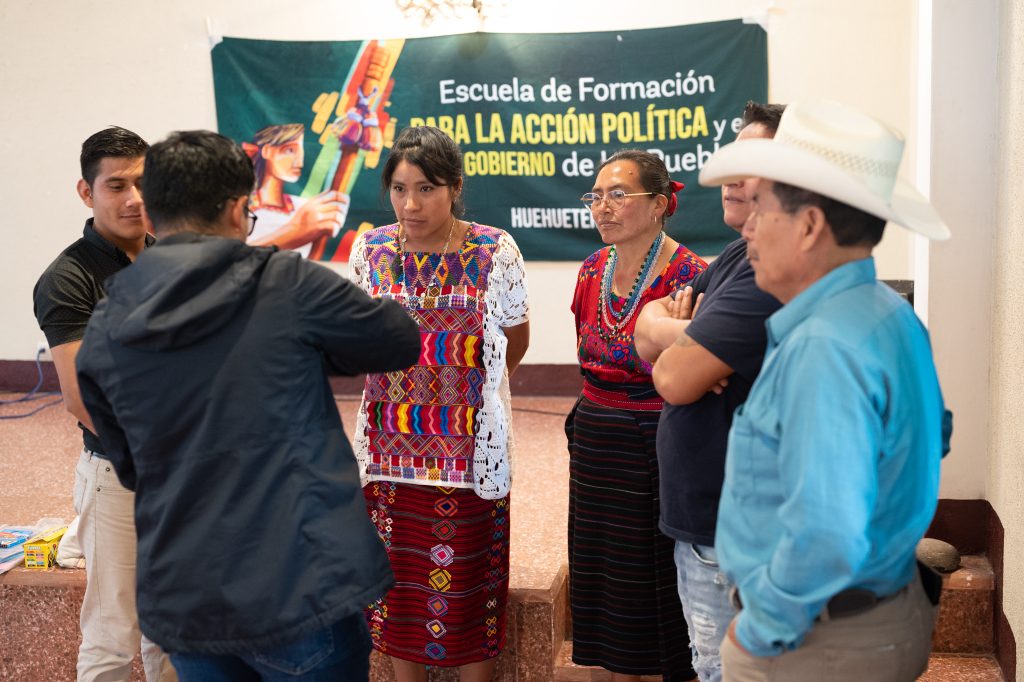
Maya Youth Build Civic Engagement in their Territories
In communities in western Guatemala, political training courses are being developed to foster leadership, awareness, and collective action. These courses are promoted by the Peace and Ecology Commission Association (COPAE) in coordination with the Maya People’s Council (CPO). These educational spaces strengthen the capacities of young Indigenous women and men to become rights-holders and political actors committed to their communities and the country.
In Santa Ana, Juan Alberto Jiménez, a member of the Community Development Council (COCODE Peoples) and a community water project manager in the village of Buenavista, has been part of this process. For him, political education has been a fundamental tool:
“I always struggled to speak in public or express my ideas well, but I learned how to do so in this course. Now I can communicate better, demand our rights from the authorities, and explain to my community what is owed to us as indigenous peoples,” he says.
The course offers concrete tools for defending territory and common goods, as well as for understanding and applying international human rights standards ratified by the State of Guatemala. Beyond individual empowerment, Juan Alberto recognizes that this knowledge strengthens the collective struggle for the recognition of cultural identity, community guidelines, and Indigenous justice.
A training process with a structural perspective
The political training process is based on Indigenous peoples’ right to self-determination and seeks to build an alternative vision for the country based on an economic, political, legal, and educational model grounded in Buen Vivir (Good Living). The diploma program is structured into four modules:
- Historical-political context of Guatemala: an in-depth analysis of the structural causes that generate inequality, exclusion, and racism, from the European invasion to the present.
- Proposals around pluri-nationalism and Buen Vivir (Good Living): concrete approaches promoted by Indigenous movements for the transformation of the State.
- Organizational and methodological foundations: how to structure processes of change based on community organization and autonomy.
- Path to structural change: how to articulate a broad social force among the four peoples that inhabit Guatemala to promote profound constitutional reforms.
The program lasts two years and is held with groups of approximately 30 people per department, with gender equity and ages ranging from 18 to 40. Upon completion, many participants actively join the Maya People’s Council, assuming leadership and decision-making roles.
“What’s most valuable is that we see a change in leadership styles: more democratic, more inclusive, and with a clear vision of transformation,” notes Udiel Miranda of COPAE.
This process demonstrates that when Indigenous communities access their own political and organizational tools, they strengthen their autonomy and their capacity to influence the construction of a more just, plural, and equitable country.